Semrush Review (2026): The Free Audit Found a Real DNS Bug
We ran Semrush’s free Site Audit and AI Visibility tools against solostacklab.net - no signup, no credit
card. We deliberately stayed in the free tier: Semrush’s own official pricing page confirms the 7-day trial
of paid plans requires a card, and its money-back guarantee explicitly excludes month-to-month billing - the
same refund-guarantee trap shape we already documented in the Surfer SEO review.
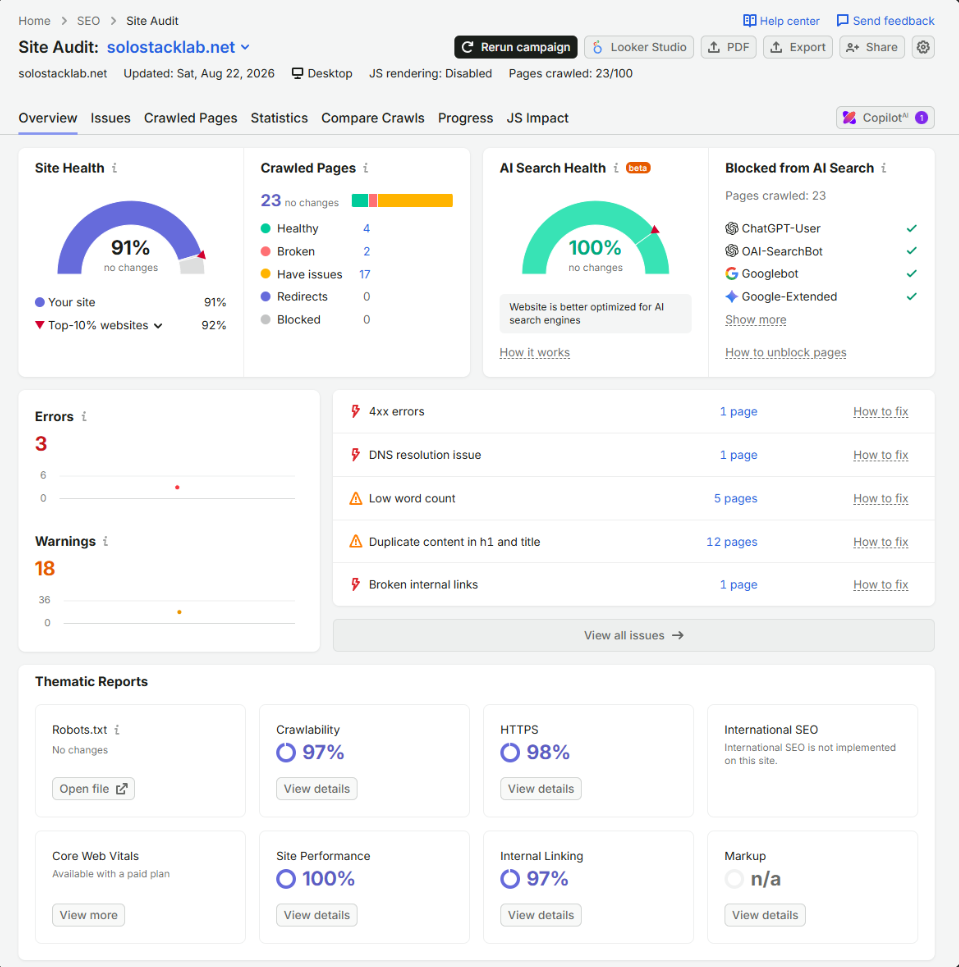
It found a real bug nothing else had caught
The audit flagged one page as “couldn’t be crawled (DNS resolution issue)”: https://www.solostacklab.net/.
We checked with nslookup and confirmed it directly - the www subdomain had no DNS record at all
(NXDOMAIN), not a redirect, not a 404. A genuine gap.
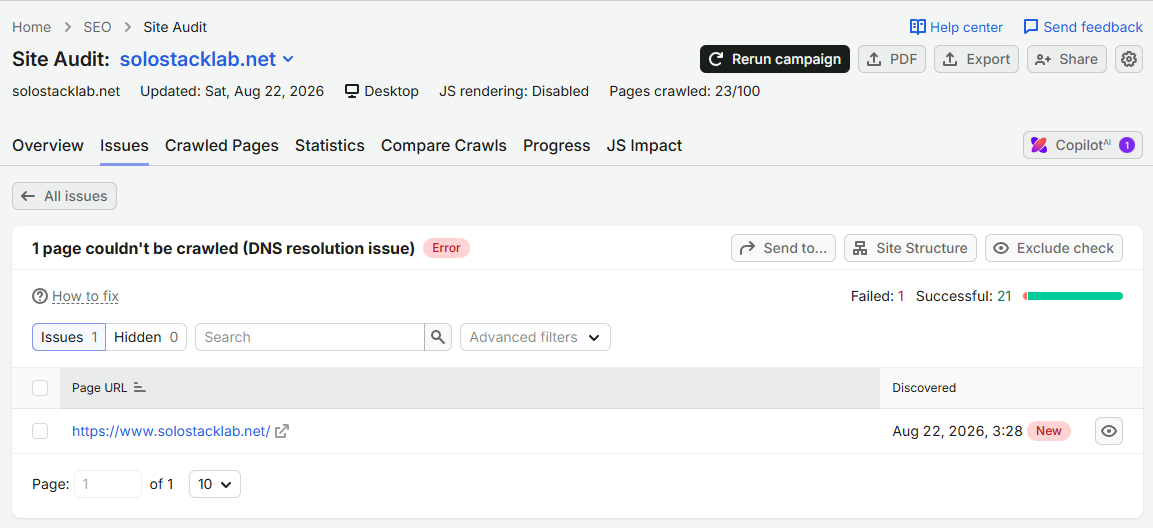
This is a bug Screaming Frog’s crawl couldn’t have caught the week before -
Screaming Frog only follows a site’s own internal links, and nothing on solostacklab.net links to the www
variant. Semrush’s audit apparently tests both forms directly rather than relying purely on discovered links.
We fixed it same-session: added www.solostacklab.net as a custom domain in Cloudflare Pages, which
auto-created the missing CNAME record and now redirects to the apex domain with SSL.
What else the free tier showed
- AI Visibility tracking (ChatGPT, AI Overview, AI Mode, Gemini) showed 0% presence - consistent with SE Ranking’s earlier 0% AI-citation finding for the same domain, a useful cross-tool confirmation rather than a one-off number.
- The same
/cdn-cgi/l/email-protection4xx “broken link” that Screaming Frog flagged also showed up here. It’s Cloudflare’s own email-obfuscation feature rewriting the email addresses we quote in the SE Ranking review - not a real bug, now confirmed by two independent tools. - Core Web Vitals is paywalled (“Available with a paid plan”) even on the free tier - the same paywalled-audit-detail pattern we found in Surfer SEO’s Auto-Optimize button and SE Ranking’s Site Audit detail view.
Two dashboard warnings that oversold themselves
“12 pages have duplicate H1 and title tags” sounds like a duplicate-content problem across the site. It
isn’t. Checking each flagged page, every one simply has its own <title> matching its own <h1> - a
deliberate choice on this site (title doubles as the on-page heading), not two pages sharing content. The
label implies cross-page duplication; the actual issue is same-page consistency, which is normal SEO
practice.
“5 pages have a low word count” flagged our five index/listing pages: the homepage, /reviews/,
/guides/, /comparisons/, and /disclosure/ - all pages that intentionally list links rather than carry
prose. The metric doesn’t distinguish a hub page from an article, so it counts every list page as thin
content by default.
A vanity metric worth calling out
The Position Tracking widget shows 100% visibility, position 1 for the keyword solostacklab.net -
i.e., this site ranks #1 for a search of its own domain name. That’s true of essentially every domain on the
internet and isn’t an achievement, but the dashboard presents it with the same visual weight as a real
ranking win. Worth knowing before reading any “position 1!” screenshot from this tool, including ours above,
at face value.
Bottom line
For a genuinely free, no-signup technical audit, Semrush’s Site Audit and AI Visibility tools are real and useful - the DNS bug they caught was a real gap in our own setup that two other tools had missed. But several of its warnings need a second look before you act on them: check what a flagged “duplicate” or “low word count” page actually is before treating the label as ground truth, and don’t mistake ranking for your own brand name for a real visibility win. See our best AI & SEO tools roundup for how it stacks up against the other audit tools we’ve tested.