Originality.ai Review (2026): It Caught Us Writing With AI
We ran Originality.ai’s free AI detector against our own published content — including this site’s own Make review — to see whether firsthand-tested, fact-checked writing that happens to be AI-assisted still reads as “AI” to a detector. No credit card is required for this: up to 3 free scans a day, 2,000 words each, no account needed.
It flagged our own review with 100% confidence
We pasted our published Make review — a real, firsthand-tested article with specific error codes, exact debugging steps, and details no spec-sheet summary would have — straight into the detector.
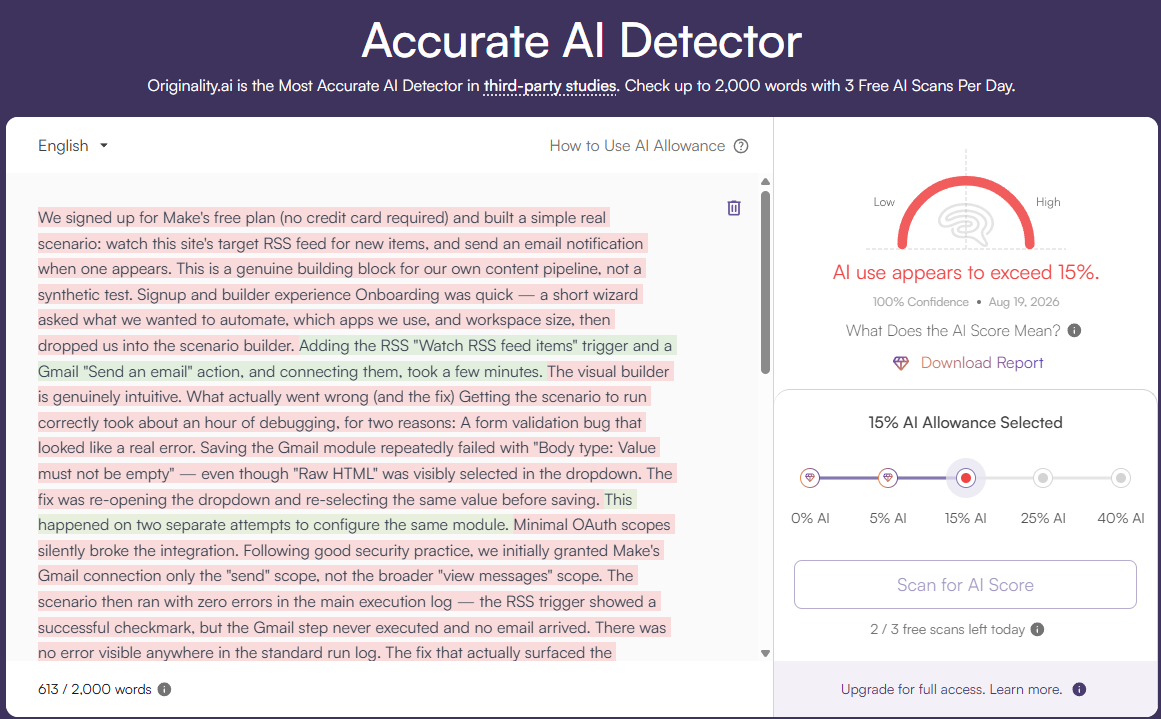
Result: “AI use appears to exceed 15%,” at 100% confidence, with nearly the entire article highlighted as AI-flagged. Only two sentences came back green. This is a genuinely useful — if slightly uncomfortable — data point for a site that uses AI agents throughout its own production: specificity and firsthand verification don’t make writing read as “human” to a detector. Those are different axes entirely. A detector is scoring style, not truthfulness or effort.
It also correctly cleared real human writing
A one-sided result isn’t proof the tool works — it could just flag everything as AI. So we tested a control: a short, unpolished, genuinely human-written passage, with no AI involvement at any stage. We deliberately avoided using a famous public-domain text (like a classic novel excerpt) for this, since a sufficiently famous passage risks being memorized by the detector’s own training data rather than judged on its actual writing style — that would test recall, not detection. Instead, we used a short, informal, personal paragraph written fresh for this test.
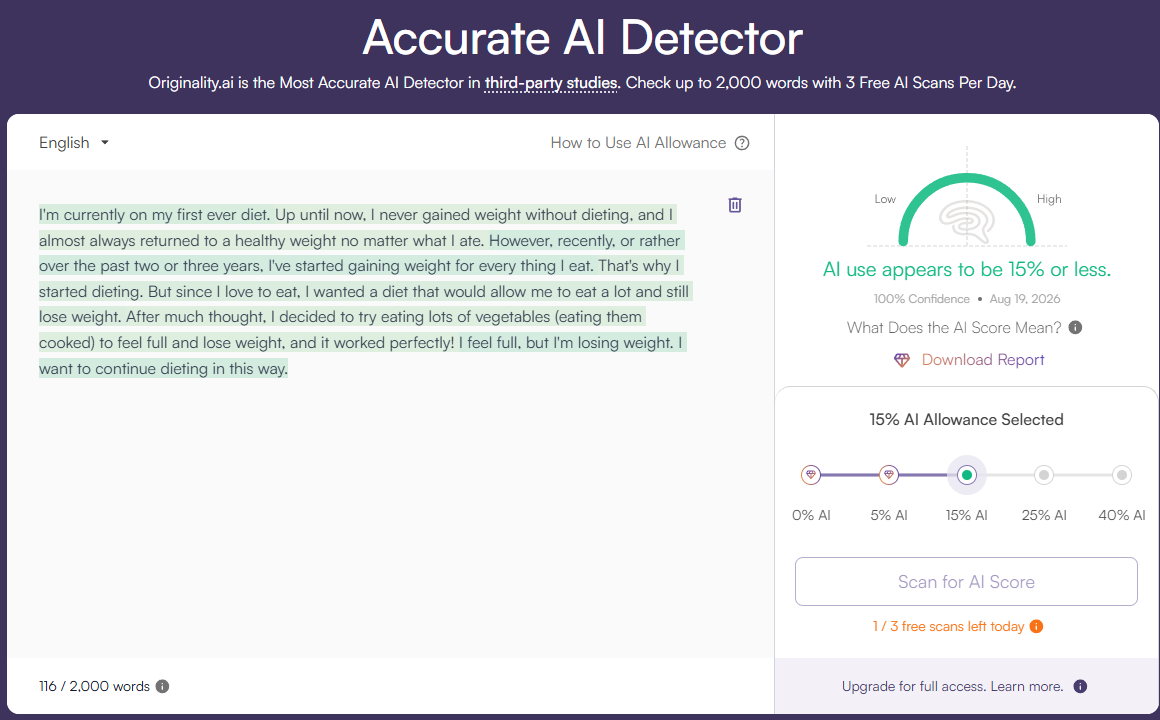
Result: “AI use appears to be 15% or less,” at 100% confidence, the entire passage highlighted green. The detector isn’t just flagging everything — it drew a clean, high-confidence line between the two samples. That’s the actual claim to evaluate, and on this small test it held up.
Plagiarism Checker: free to sign up, not free to use
The AI detector’s free tier works without an account. The Plagiarism Checker does not — every page pushing it says “Sign up now” or “Sign up to access the full version.” So we created a free account (email and password only, no card asked for) specifically to test it.
The account started with a balance of 0 credits. Scanning the same 613-word Make review for plagiarism required 14 credits — the app is a credit-metered system distinct from the free public detector page — and returned a plain “Not enough credits” error before any scan could run.
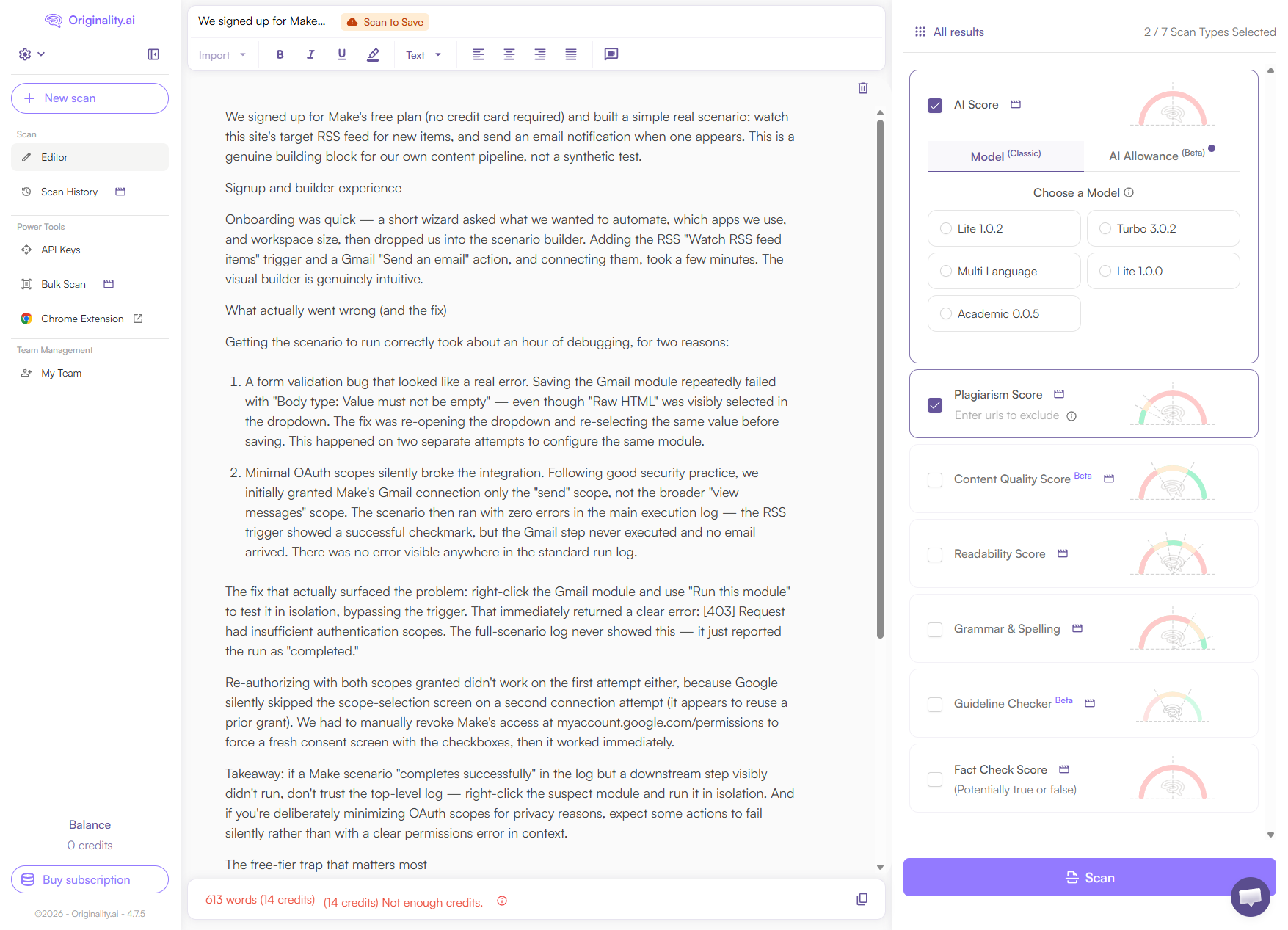
There’s no free-credit grant on signup, and no way to actually run a plagiarism check without buying a subscription first. Functionally, the free tier is the AI detector alone — the plagiarism side is a paid feature dressed up as something you can “sign up” to try.
Pricing
- Pro: $14.95/mo billed monthly, or $12.95/mo billed annually ($155.40/yr) — 2,000 credits/mo (1 credit ≈ 100 words)
- Enterprise: $179/mo billed monthly, or $136.58/mo billed annually — 15,000 credits/mo
Additional credits can be purchased separately and expire 2 years from purchase if unused.
Bottom line
For the specific job of AI detection, Originality.ai’s free tier is genuinely usable and, on this small test, accurate in both directions — it doesn’t just flag everything as AI, and it didn’t clear our AI-assisted writing just because the underlying facts were real and verified. That’s a meaningful distinction for anyone publishing AI-assisted content who wants to know how it actually reads. The Plagiarism Checker is a different story: it’s gated behind a paid plan the moment you try to use it for real, no matter how the marketing pages frame the free signup.
This is an affiliate link — see our disclosure policy.