Ahrefs Free Review (2026): It Told Us the Truth
Google Search Console’s “Links” report has never worked for this site. It has shown “processing data, check again in a day” since launch, so we had no idea who links to us. That’s a real gap: this site’s whole growth plan depends on getting other sites to reference it, and we couldn’t measure the starting point.
Ahrefs’ free public Backlink Checker gave us a first look with no signup (behind a human-verification check we completed by hand): Domain Rating 0, 337 backlinks, 332 linking websites, only 4% dofollow. To see the full list we signed up for Ahrefs Free, which Ahrefs’ own site says is free for websites whose ownership you verify, with no limit on the number of verified sites.
Signup: email only, and no card
Ahrefs’ pricing page says it never runs discounts, and points website owners to Ahrefs Free instead of a trial. Neither that page nor the Ahrefs Free page says whether a card is needed, so we found out by doing it. The signup form asked for an email address and nothing else.
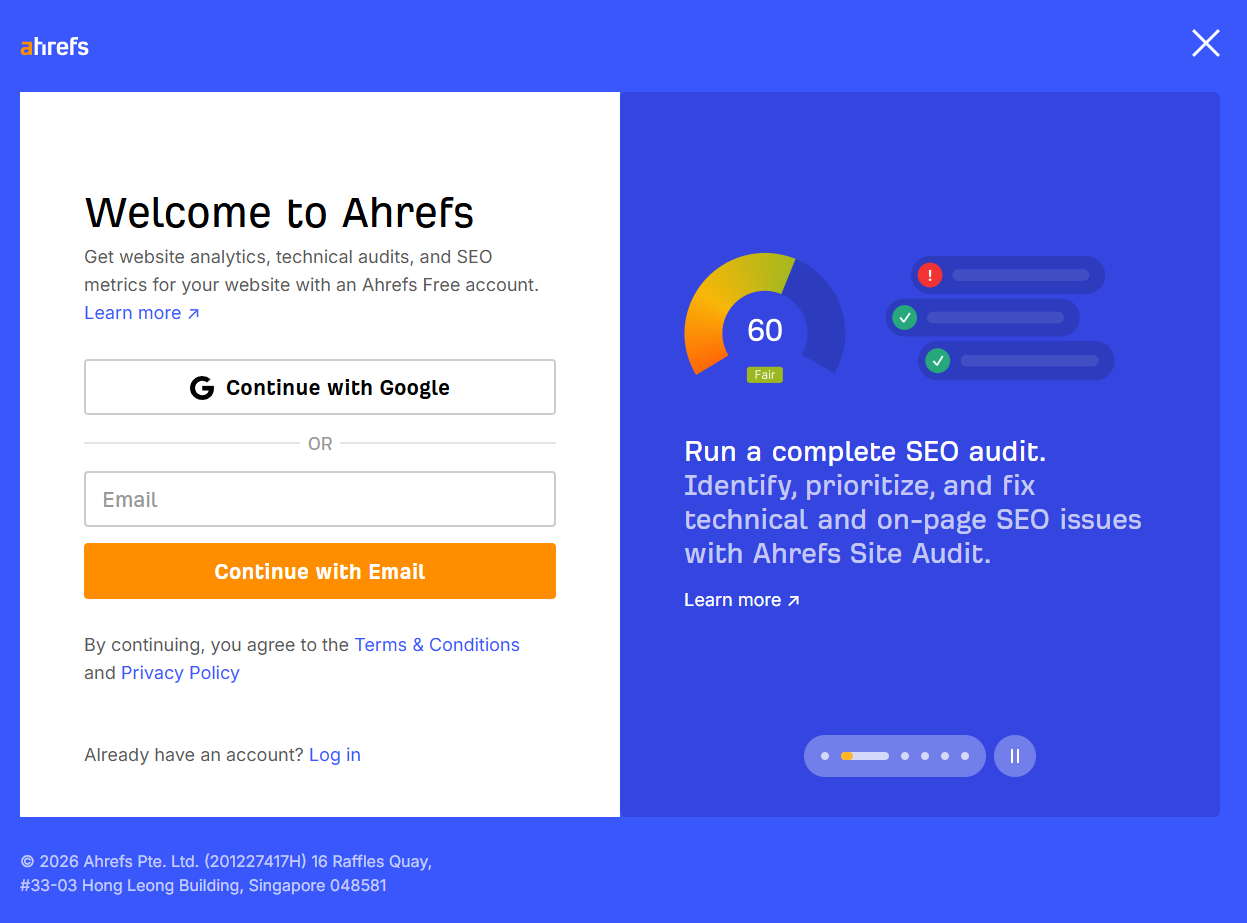
The next screen asked for company size, role, and where we heard about Ahrefs, with the weekly newsletter opt-in switched off by default. At no point in the whole test were we asked for card details.
Connecting Search Console: optional, separate, and unchecked by default
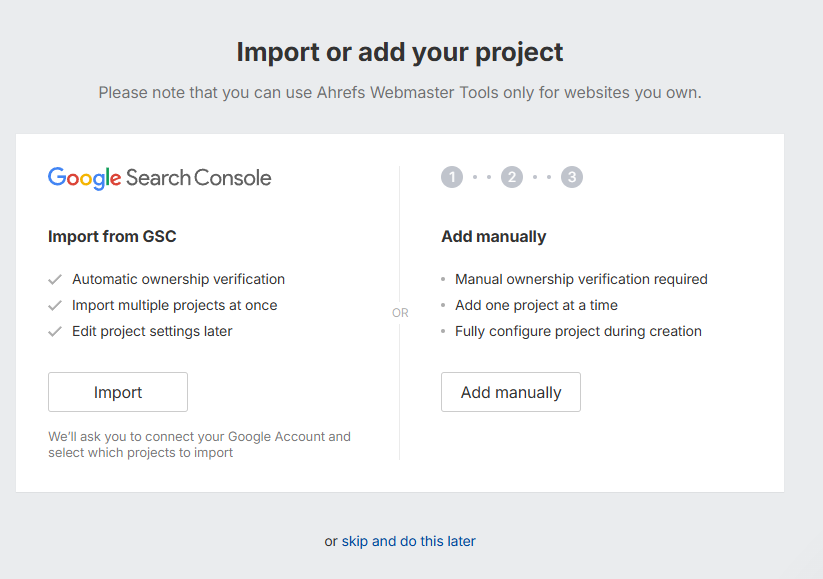
To verify ownership automatically, Ahrefs offers an “Import from GSC” option. Signing in with Google first shares only your name, profile picture, and email address. Then comes the screen that matters: the actual data permissions.
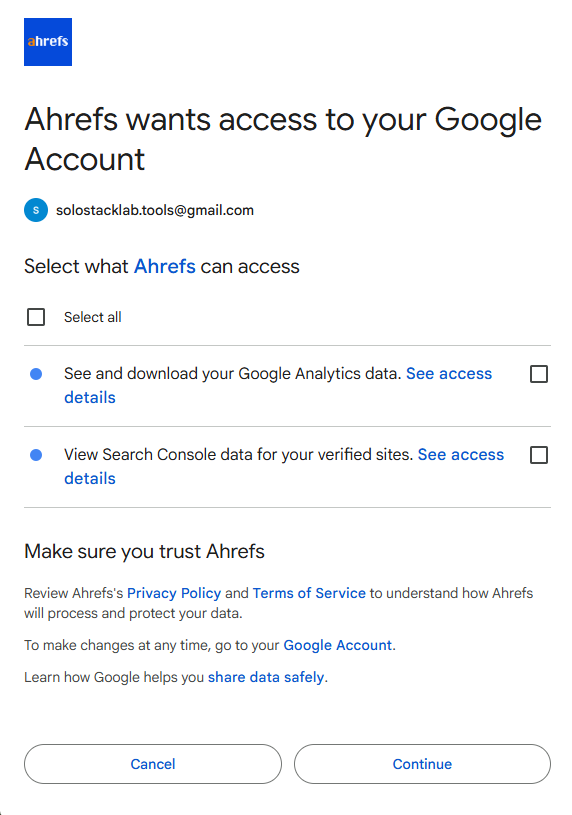
There are two separate checkboxes, both unchecked by default: “See and download your Google Analytics data” and “View Search Console data for your verified sites.” We ticked only the second, since this site doesn’t use Google Analytics, and Ahrefs imported the project without the other. That’s a noticeably tighter default than Activepieces’, which asked for four Gmail scopes at once.
One small naming wrinkle: ahrefs.com says the product was renamed from Webmaster Tools to Ahrefs Free, but the import screen still says “you can use Ahrefs Webmaster Tools only for websites you own.”
Defaults that switch themselves on
On the next screen, “Start first audit now” and “Schedule weekly audits” were both already on. “Crawl external links” was off.
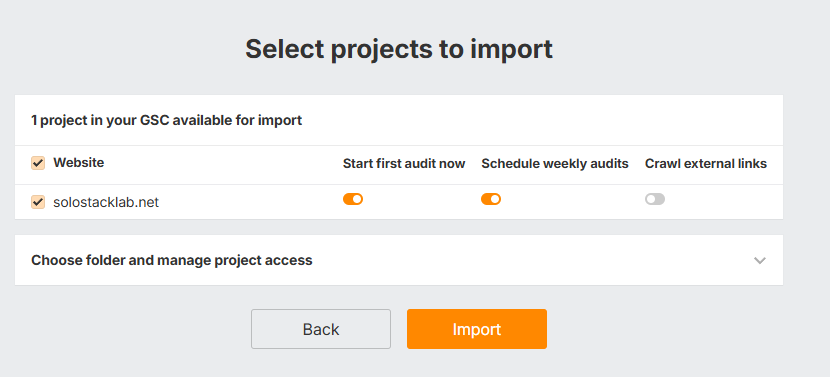
For a site of about 30 pages that’s negligible against the free plan’s 5,000 monthly crawl credits, but it is a recurring crawl you didn’t choose. When we looked at the project overview on September 20, Health Score still read “Get started,” so we couldn’t say anything about the audit itself that day. We read the first results on September 21 (see “Site Audit: first look” below). We did not evaluate Web Analytics in this test.
The finding: 332 linking domains, one real one
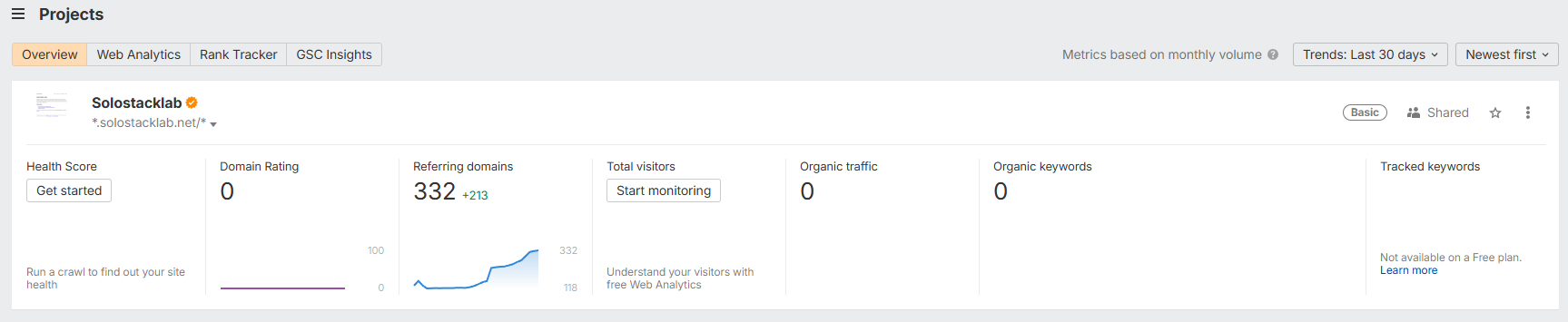
The project overview showed the same 332 referring domains as the free checker, up 213 in the last 30 days, with a Domain Rating of 0 and zero organic traffic and keywords.
The Referring domains report, sorted by Domain Rating, is where it gets clear. Almost every row carries a red SPAM label that Ahrefs applies itself. The exceptions, in the full list we copied out of the report, were exactly two:
- indiehackers.com - Domain Rating 81, five links to us, none of them dofollow, first seen August 31. This is the real one, presumably from our own Indie Hackers profile and posts (we didn’t open the individual links to confirm which).
- brightboosthub.shop - Domain Rating 0, first seen the day we tested. Almost certainly spam that’s simply too new to have been classified, though we didn’t verify that.
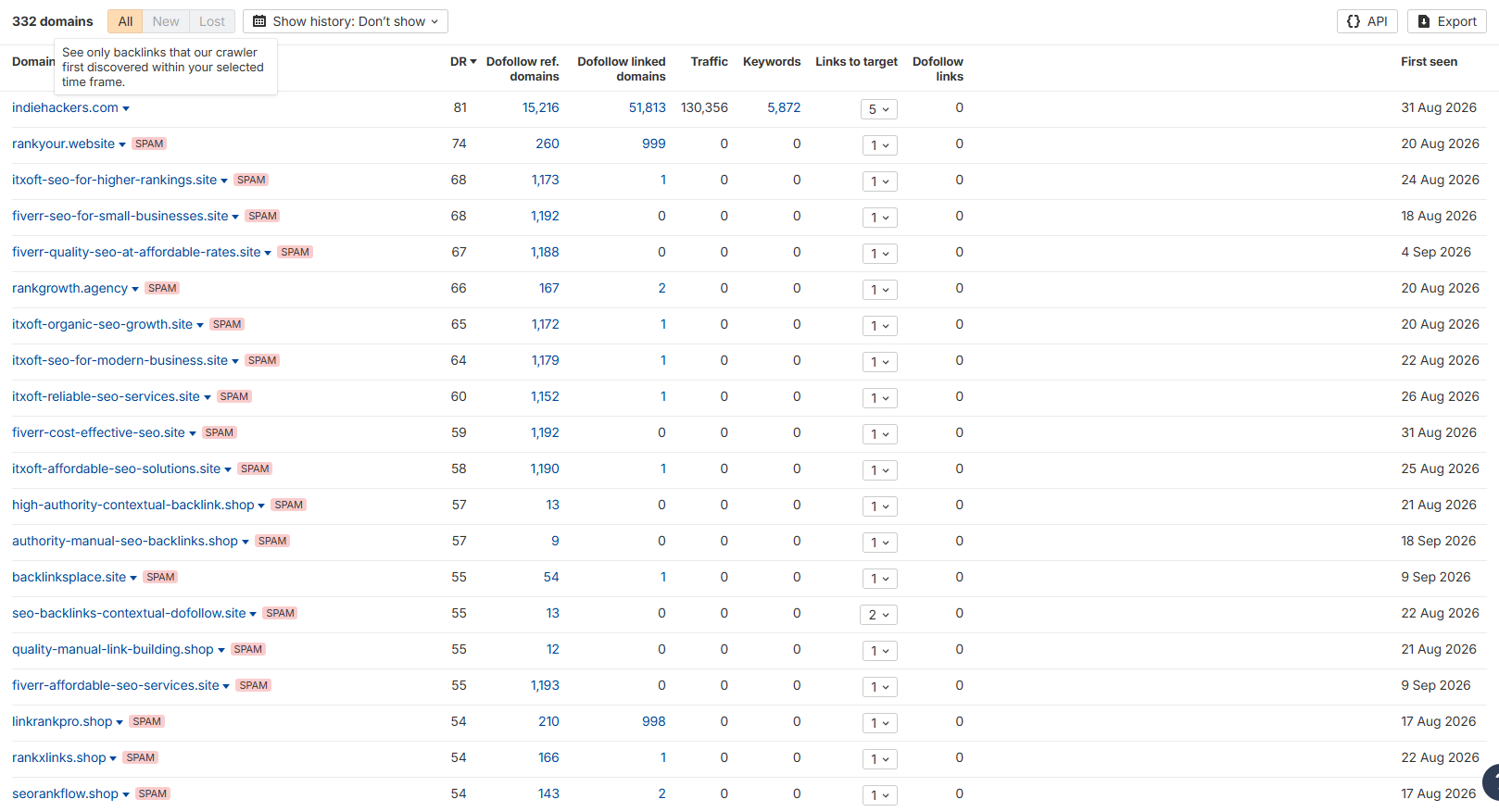
The spam is automated. The linking pages are generated “SEO services” and “PBN links for sale” pages that insert our
domain into a template - one still contained the literal placeholder {site_name} where a domain should have
been. They arrive in waves (first-seen dates cluster in mid-August, early September, and mid-September, and
the newest was the day we tested). Many of those rows show a Domain Rating of 40 or more, which looks inflated:
those sites’ own backlinks number in the thousands and come from the same kind of spam. Our own Domain Rating
stayed at 0 regardless.
What to do about it: nothing. Google’s own Search Console help says most sites don’t need the disavow tool, that it’s meant for sites with many spammy links that are causing or may cause a manual action, and that Google works to stop other sites’ behavior from hurting yours. The disavow tool also isn’t supported for Domain properties. We didn’t disavow anything.
One more absence worth noting: our link from a public GitHub issue we filed on September 18 didn’t show up yet. Ahrefs may simply not have crawled it, so that’s not proof it isn’t counted.
Recheck, September 21: every domain in the report except indiehackers.com now carried the SPAM label, including brightboosthub.shop, which had been unlabeled the day before. That leaves the real count at one.
Site Audit: first look (September 21)
The first audit’s results were ready when we looked on September 21. Its overview showed a Health Score of 96 (“Excellent”), with 89 URLs crawled (35 internal pages and 54 resources such as images and scripts) and 46 issues: 5 errors, 8 warnings, 33 notices. The dashboard’s own caption says Health Score “reflects the proportion of internal URLs on your site that don’t have errors,” so it measures how few pages have errors, not how good the site is.
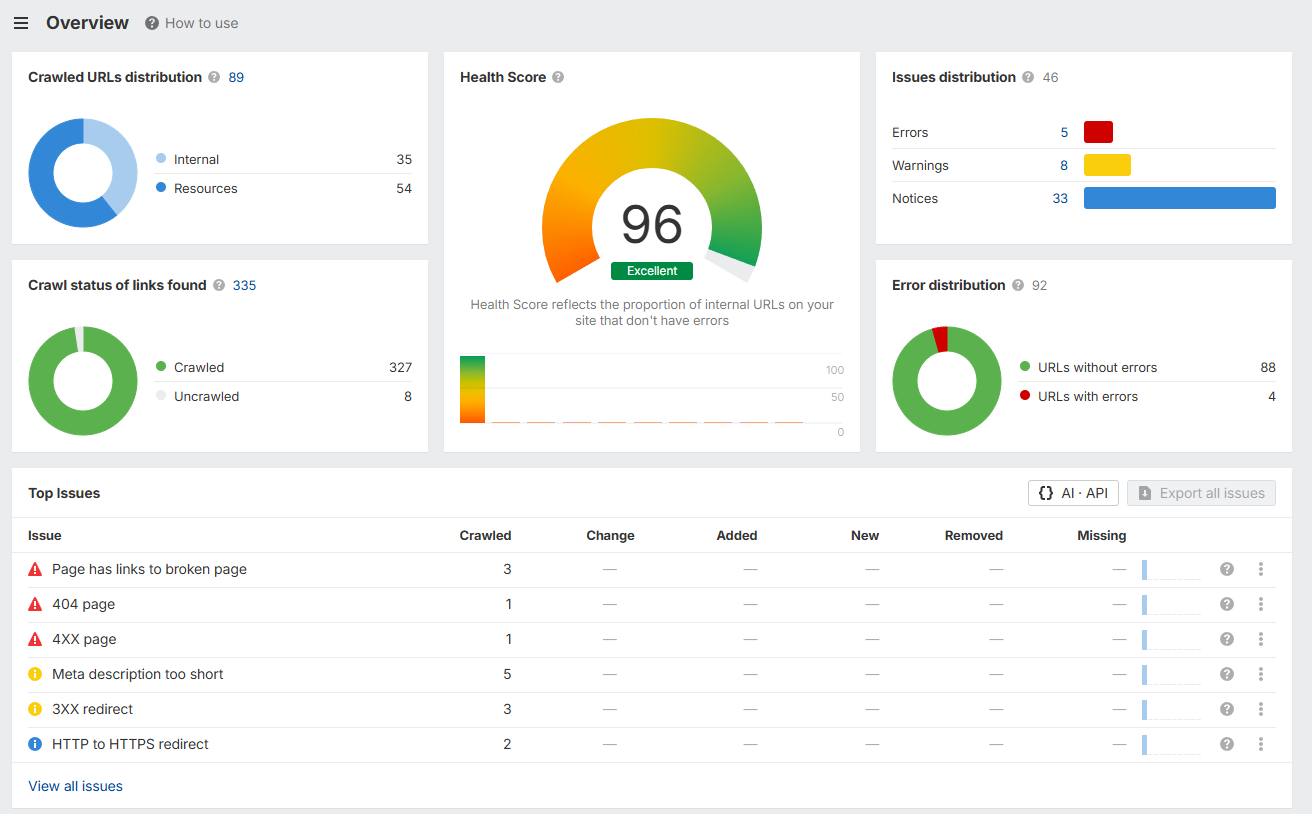
We opened the errors instead of taking the score at face value. The one “404 page” turned out to be
/cdn-cgi/l/email-protection, linked from three of our pages (the Semrush vs SE Ranking comparison, the About
page, and the SE Ranking review), each with the anchor text “[email protected]”:
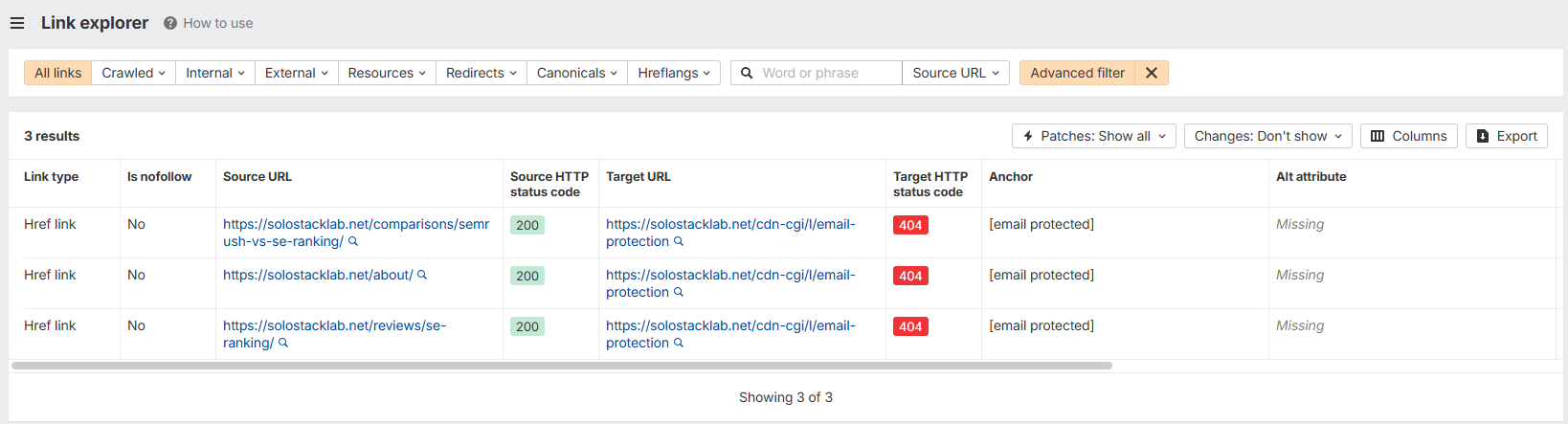
That is Cloudflare’s email obfuscation. The page source carries a placeholder link, and the visitor’s browser swaps in the real address, so a human never sees a broken link. A crawler that doesn’t run the script does. The three error rows (“Page has links to broken page,” “404 page,” “4XX page”) appear to trace back to that one URL, so we counted it as a single false alarm and changed nothing.
The five “Meta description too short” warnings were our methodology, disclosure, and the reviews, guides, and comparisons index pages, with descriptions of 65 to 91 characters. All five get zero organic traffic, we didn’t check the character threshold Ahrefs uses, and we left them alone. They’re also all static pages that our own content check doesn’t cover.
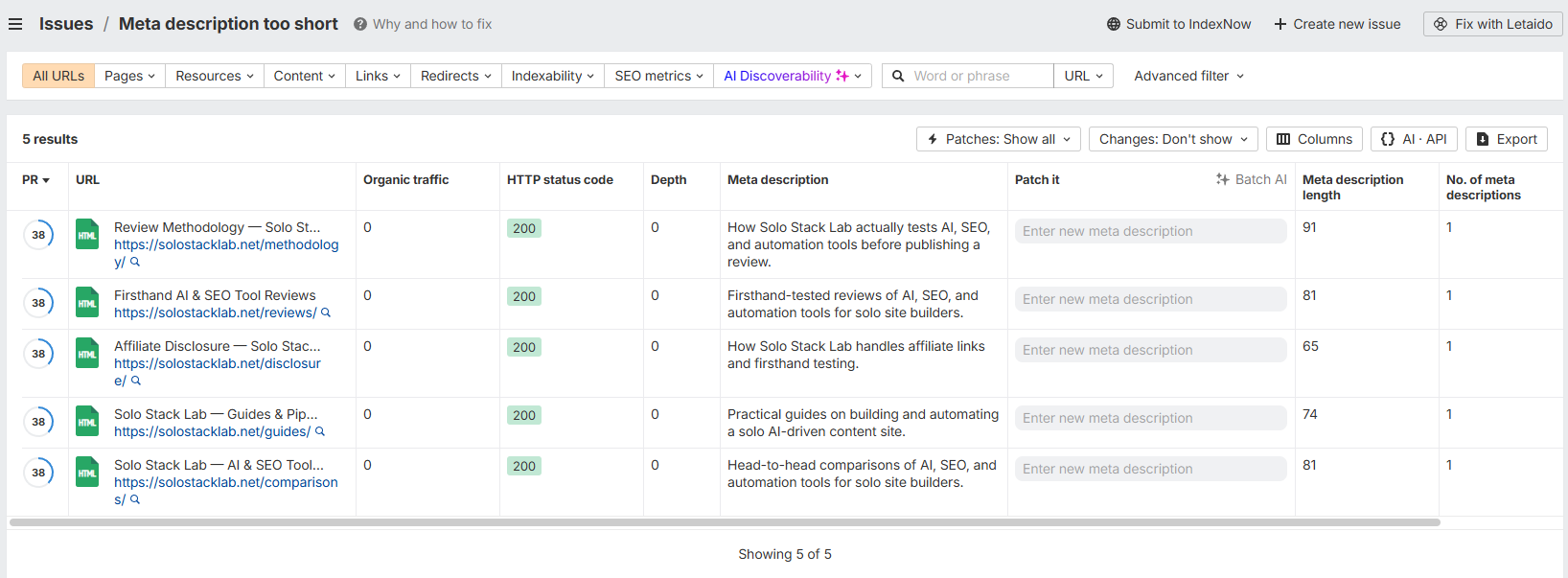
So, for this site: the audit found no real bug that we hadn’t already fixed, plus one false alarm. One limit on that conclusion: our 404 page was already live before the first crawl, so we can’t say whether Site Audit would have caught the soft-404 problem it replaced.
Where the free tier stops
Ahrefs’ page says Site Explorer shows up to 1,000 backlinks and keywords at once on the free plan. Our list was small enough to read on screen, but exporting it wasn’t possible:
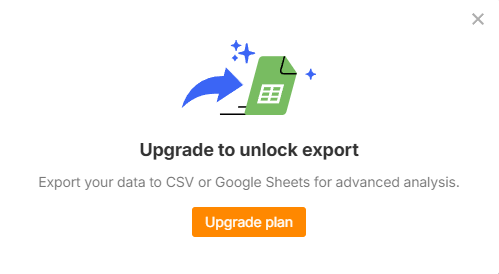
Tracked keywords is also marked “Not available on a Free plan” on the project overview. Neither limit got in the way of the question we actually came with.
Affiliate program
Ahrefs has none. Its own blog post from June 2023 says it has had no affiliate program for years and has no plans to relaunch one, and nothing on the current site suggests otherwise. That post is three years old, so treat this as “no public program that we could find,” not a guarantee. It’s reviewed on the same standard as every other tool here.
Bottom line
Ahrefs Free did the one thing we needed and couldn’t get anywhere else: a real, filterable list of who links to us, with the junk labeled for us. The honest reading of that list is not flattering. After five weeks this site has one genuine referring domain, and none of its links are dofollow. That’s the true starting line, and it’s more useful than the flattering “332” the dashboard leads with. What we didn’t test - Web Analytics and the keyword data - is a large part of the product, and our Site Audit look was a single first crawl, so this is a review of the free backlink view, the signup flow, and one audit, not of Ahrefs as a whole. See our step-by-step guide to sanity-checking a backlink report for the general version of the process we used above. See our roundup of every tool we’ve tested for where it fits.